
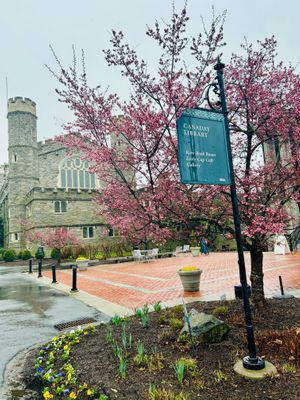
The Area/Town: Located on Philadelphia’s Main Line (a historic stretch of swanky suburbs just outside the city), Bryn Mawr College offers a quiet residential campus with easy access to center city Philly for internships, research, museums, restaurants, and cultural events. A train station just off campus allows students to reach the city in less than 20 minutes.
The town of Bryn Mawr is directly adjacent to campus, so students can walk to coffee shops, bakeries, bookstores, casual restaurants, and an independent movie theater. The town feels small and intellectual, with many spots serving as favorite study hangouts.
The Campus/Students: Bryn Mawr’s campus features stone Gothic buildings, ivy-covered walls, courtyards, and tree-lined paths, creating a historic atmosphere. Iconic landmarks like Pembroke Arch and the Cloisters complement the modern Park Science Center and Student Life and Wellness Building.
With about 1,350 undergrads, Bryn Mawr is intentionally small and academic. Mawrters, as students at the all-women’s college are known, describe themselves as intellectually curious, collaborative, and deeply engaged. The college itself values maturity, curiosity, and intellectual risk-taking, seeking out students who pursue their passions with conviction.
As one of the original “Seven Sisters” women’s colleges, it’s no surprise that community traditions are also a big part of campus life. Events like Lantern Night, Step Sings, and May Day connect students across class years and reinforce the strong sense of belonging that Bryn Mawr is known for.
One of Bryn Mawr’s most distinctive strengths is its memberships in the Bi-College (BiCo) partnership with Haverford, and the Tri-College Consortium (TriCo), which includes Haverford College and Swarthmore College. Participation is high (over 2,000 annual cross-registrations in Bi-Co alone), making it easy for students to take classes, join clubs, and attend events across the three campuses. A free shuttle bus runs frequently between Bryn Mawr and Haverford, and connections extend to Swarthmore as well, giving students access to the resources of three elite liberal arts colleges.
The college has also invested in student wellbeing, including a recent $1.3 million wellness grant to expand mental health programming and student support services.
Academics: Bryn Mawr is known for a rigorous liberal arts curriculum that emphasizes close relationships between faculty and students. Classes are discussion-driven, writing-intensive, and focused on original research. Intellectual curiosity is standard fare here; conversations started in class often continue at meals, in study groups, or at campus events.
Research opportunities, faculty mentorship, and close collaboration are central to the experience. Students are encouraged to pursue independent projects, internships, and interdisciplinary work.
Popular majors include:
Biology
Economics
Psychology
English
Political science
Mathematics and the sciences
The college recently introduced a new Creative Writing major, reflecting growing interest in literary and interdisciplinary study.
Students also benefit from extensive faculty mentorship and research opportunities. Bryn Mawr consistently ranks among the top producers of Fulbright scholars, reflecting its strong preparation for graduate study and global scholarship.
Cost: The 2025-26 total Cost of Attendance is just over $90,000, but Bryn Mawr meets 100% of all demonstrated need. And starting in fall 2026, tuition will be free for families earning $175,000 or less.
Bryn Mawr is worth a look for young women seeking a deeply intellectual liberal arts environment with equally strong programs in the sciences and humanities, a supportive and close-knit academic community, and the rich opportunities that come from studying within a consortium of top colleges just minutes from a major city.
Visit Bryn Mawr's website to learn more and see if it’s a good fit for you.